
The Democratic Republic of Ethiopia
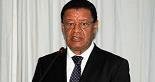
Dr. Mulatu Teshome
President of Ethiopia
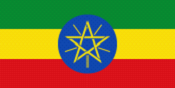
National Flag
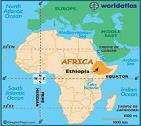
Location in Africa
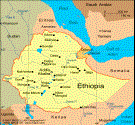
Map of Ethiopia
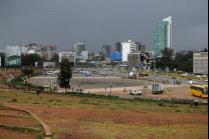
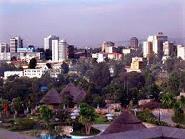
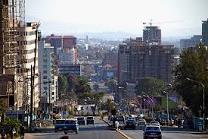
The Capital Addis Ababa
Country profile
Ethiopia is Africa’s oldest independent country and it is the second largest in terms of population. Apart from a five-year occupation by Mussolini’s Italy, it has never been colonized. It has a unique cultural heritage, being the home of the Ethiopian Orthodox Church – one of the oldest Christian churches – and a monarchy that ended only in the coup of 1974.
Ethiopia is considered by many to be one of the most under-developed nations in the world. But within its African boundaries, lies a nation filled with a rich culture and heritage. It is a nation that has suffered much and seen much. Yet it has lived through and survived to this day, resonating how much strength its people contain. The economy is one of the fastest growing non-oil economies in Africa with a growth rate of 3.02% per year. It depends heavily on agriculture, which is often affected by drought. It is one of Africa’s leading coffee producers. With a 2014 population of approximately 96.5 million, Ethiopia is the largest landlocked country in the continent of Africa. Ethiopia is also the second largest country in Africa, behind only Nigeria in population.
Ethiopia is home to various ethnicities, predominantly the Oromoí and Amharaí groups, with Islam and Christianity as the most commonly practiced religions. Additionally, the capital of this country is Addis Adaba. Being as old as two millenniums, its cultures and traditions hold family as a significant part of Ethiopian life, sometimes even surpassing the significance their careers or businesses might have. Furthermore, Ethiopians are hospitable and respectful of other nationalities, and their speech is characterized by a certain amount of eloquence and softness. They represent a people who value honor and pride, and bestow it on those who respect their way of life and their rich history. The people of Ethiopia have proven to be one of the strongest on the face of the earth, having endured massive hardships. If it is given a little assistance, Ethiopia will be able to build on the strength of its inhabitants in order to increase the strength of the nation itself.
A brief history of Ethiopia
Ethiopia served as a symbol of African independence throughout the colonial period, and was a founder member of the United Nations and the African base for many international organizations. The capital Addis Ababa is home to the African Union, and important United Nations branches, and with nearly every foreign embassy from around the world represented, Addis Ababa is often referred to as the capital of Africa.
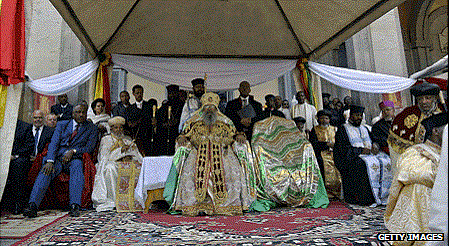
Ethiopia’s Orthodox Church is a defining feature of national identity
Ethiopia has suffered periodic droughts and famines that led to a long civil conflict in the 20th Century and a border war with Eritrea. In the first part of the 20th Century Ethiopia forged strong links with Britain, whose troops helped evict the Italians in 1941 and put Emperor Haile Selassie back on his throne. From the 1960s British influence gave way to that of the US, which in turn was supplanted by the Soviet Union. Eritrea hived off in 1993 and a border dispute escalated into full-scale war in 1999. Border tensions persist. Ethiopian troops helped oust Islamists who controlled southern Somalia in 2006. Ethiopia is seen as a key US ally
Drought
Although it has had fewer of the coups that have plagued other African countries, Ethiopia’s turmoil has been no less devastating. Drought, famine, war and ill-conceived policies brought millions to the brink of starvation in the 1970s and 1980s. In 1974 this helped topple Haile Selassie. His regime was replaced by a self-proclaimed Marxist junta led by Mengistu Haile Mariam under which many thousands of opponents were purged or killed, property was confiscated and defense spending spiraled. The overthrow of the junta in 1991 saw political and economic conditions stabilize, to the extent that the country is regarded as one of Africa’s most stable.
Eritrea
Eritrea gained independence in 1993 following a referendum. Poor border demarcation developed into military conflict and full-scale war in the late 1990s in which tens of thousands of people were killed. A fragile truce has held, but the UN says ongoing disputes over the demarcation of the border threaten peace. Many Ethiopians depend on food aid from abroad. In 2004 the government began a drive to move more than two million people away from the arid highlands of the east in an attempt to provide a lasting solution to food shortages.
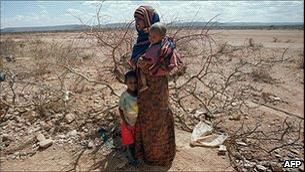
Drought-prone and short of food, Ethiopia has suffered a series of famines in recent decades
Despite its hardships, it has one of the most interesting histories to learn about. It is a must visit country if you want to learn about Africa. Read a little more about the interesting history of this country. Ethiopia is just emerging from a very rough communist state and is just starting to flourish. Because the country was so closed off to the rest of the world, the people of the country are very open and curious about the outside world. Ethiopians are literally ingesting everything they can get their hands on from music, dress, and even culture. One of the most fascinating things about the country is that it is a very ancient culture. Their language, Amharic, is one of the oldest written languages in the world. Add on the fact that Ethiopia has tourist attractions like feeding hyenas, the city known as the 2nd Jerusalem, African Safaris, and even a real world Camelot, you have quite a country & culture to experience. By the way, did you know it is one of the cheapest places to travel in Africa?